
Project Spotlight: Life Science Talent Pipeline – Scaling Proven Workforce Models
Sector: Life Science
Lead Organization: Life Science Washington
Challenge: Washington’s life science sector continues to rely on out-of-state talent. As the industry grows into a top 10 national cluster, employers face an urgent need for locally trained biomanufacturing technicians, lab technicians, and quality control specialists.
Solution: Scale and strengthen high-demand training programs at Spokane Community College, Shoreline Community College, and UW Bothell’s Center for Biotechnology and Innovation Training (CBIT). Deepen partnerships with employers, including Jubilant HollisterStier, Fred Hutchinson Cancer Center, Pfizer, Plurystic, Just EvoTech, Inventprise, Bristol Myers Squibb, and Allen Institute for Brain Science.
Projected Outcomes:
- 330 students enrolled.
- 26 students engaged in paid internships or worksite learning.
- 53 employers actively supporting training and program delivery.
- 40 students earning industry-recognized credentials.
- 140 students applied for entry-level positions.
Impact:
- Students: Clear, reliable pathways into lab tech and biomanufacturing roles, supported by strong hiring outcomes across CBIT, Shoreline, and JHS–Spokane CC programs.
- Employers: A dependable local talent pipeline reinforced by consistently high hiring rates across regional training programs.
- Educators: Instruction aligned with industry needs, strengthened by collaboration with employers and shared program models.
- Systems: Industry-approved curriculum scaled across multiple colleges, creating a more unified and aligned statewide life sciences talent-development system.
Project Update
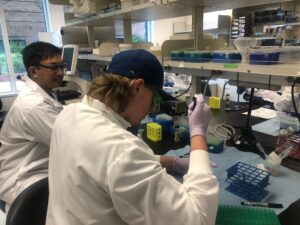
Life Science Washington is scaling three industry-aligned life sciences programs: the Shoreline Community College Biotechnology Program, UW Bothell’s Center for Biotechnology Innovation & Training (CBIT) and the Jubilant HollisterStier (JHS) biomanufacturing training program with Spokane Community College. Partner employers are co-teaching, hosting internships and working with faculty on curriculum.
Through August 2026, the project has enrolled 169 students, about half of the 330-student target. Enrollment peaked in September 2025 and March 2026. Students earned 24 industry-recognized credentials and 41 have engaged in paid internships or worksite learning. Employer engagement stands at 30 active employers against a target of 53.
Highlights and Impact
- Paid internships and worksite learning: Fourty-one students have engaged in paid internships or worksite learning, above the 26-student target.
- Industry-recognized credentials: Twenty-four students have earned credentials so far, 60% of the 40-student target.
- Employer engagement: Thirty active employers against a target of 53.
Looking Ahead
- Winter–Spring 2027: A JHS biomanufacturing cohort of about 15 students and the launch of industry-recognized credentials at CBIT, UW Bothell.
- Ongoing: Continued recruitment to fill program capacity and meet industry demand.
- Demand Update: An updated analysis of high-demand life sciences occupations, including how AI is changing roles, planned for early 2027.
Resources
The Roadmap to ROI infographic is an extremely relevant (https://bit.ly/RoadmapToROI) and practical guide for employers designing early talent programs. It fits this project’s employer audience.
For questions about this project, please contact Srikant Iyer, srikant@lifesciencewa.org.